A Tour of the Sewing Room, Part 3

Here’s the conclusion to our little sewing room tour — if you missed parts 1 and 2, they are here and here.  In this episode, while we’ll be discussing a few last tools, we’ll also discuss some sewing room organization.  A quick Pinterest search revealed a gag-worthy gallery of pegboard and plastic storage — while those work fine for some people, I don’t like them.  And while I still haven’t totally been able to ditch my plastic storage boxes, their ranks have been greatly reduced.

While we’ve covered most of my favorite tools, there are a few left.  One of the most important: prewaxed thread for hand sewing (below).

NBT Furrier Waxed SkeinI got hooked on this stuff when working at David’s Bridal, and I can’t live without it now.  It’s a little pricey, so I only have it in white, off-white, and black.  Since it’s waxed, it resists knotting and tangling when you’re sewing with it.  And since it’s conveniently precut, you just pull a single strand out, thread your needle, and you’re good to go.  It’s wonderful for hems, buttons, thread tacks, and virtually any other hand sewing you can think of.

NBT Furrier Waxed Skein

It’s produced by New Bedford Thread Company (and made in the US, check that out!!) and is available from a number of online suppliers (the best price I found when I checked recently was from Wawak).  Buy one and try it.  It’s the best thing since sliced bread.

Vintage dressmaker's form

Another of the things I can’t live without:  My vintage dressmaker’s form, affectionately known as Miss Money (a reference to Hello, Dolly!).  I have two, actually — Dolly, my modern Singer dress form, isn’t pictured.  I use them both — Miss Money is MUCH better made, with a sturdy base.  Dolly has a plastic base and is prone to toppling, but, on the other hand, she has nifty little numbered dials that allow you to know exactly what measurement you’re setting her to.  I don’t recommend either of them for precise alterations or anything like that, but they’re fabulous for draping (which is a very fun technique, and indispensable for working with knits if you can’t find a pattern) and for determining trim placement on a garment (I use them both a lot sewing reproduction Civil War day dresses and ballgowns).  And, when they’re not in use, it can be nice to display a vintage dress on one or both of them.

Vintage drawers for thread

This is one of my latest finds, and I just have to brag about it. I’ve been trying to find one since I was in high school (I graduated in ’06), and I just found this drawer set at an estate sale.  Drawers are the best thing for storing thread.  I’m sure some of you will disagree with me, but I prefer it to a wall-mounted thread rack for a number of reasons.  First, drawers keep thread from getting dusty.  Second, it’s easier to chuck a spool of thread into a drawer than to make sure it gets put back on its special little peg (and let’s face it, if I can’t put it up instantly, it doesn’t get put up).  And thirdly, when the thread is sorted by color, it’s quicker to find what you want.  I have a drawer for neutrals; one for blues and greens; one for yellows, pinks, reds, oranges, and purples; and one for specialty threads (metallic, quilting, etc.) and bobbins (which are in bobbin boxes to prevent entanglement).  Up till last week, I had used a couple sets of little plastic drawers (two of which are shown on top of the new wooden drawers).  They weren’t lovely, but they worked nicely for a long time until I was able to upgrade.

Antique store display rack

Another favorite thing is my antique garment rack for my in-progress pieces.  Again, this is a recent upgrade; previously I had used a modern store display T-rack that I got on Craigslist.  When this one came in at the antique store where I work, I pounced on it. It was a big splurge for me, but it was exactly what I wanted.  Advantages:  You can see exactly what you should be working on, and your nice clothes don’t get wrinkled and dusty on the floor.

Pencil cup used for sewing supplies

Another of my favorite little tools is this pencil cup that I got on clearance for a dollar at Office Max while in college.  I keep pencils, pens, marking pens, a hem gauge, and my seam rippers in it for easy accessibility.

Display of vintage sewing notions

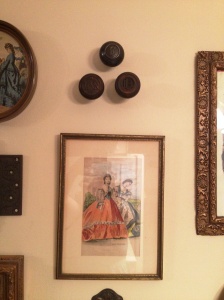
Finally, just because it’s a sewing room doesn’t mean that we can’t have fun decorating it.  Here’s my favorite decoration — a shadow box (yard sale find!) with a few of the vintage sewing notions I’ve picked up over the years.  The earliest pieces are some early 1900′s needles (in original packaging) and a card of Art Nouveau buttons that I got from the Nashville Flea Market.

And, in case you were curious, I’m being brave and including a picture of my tiny little sewing room as it looks right this minute (amid unfinished myriads of unfinished projects, a freebie Craigslist desk, a wrapping paper storage box that’s holding fabric bolts, a couple hundred patterns, and over 200 books…..).  It’s still not quite finished — and, realistically, probably never will be. I didn’t clean up for the picture, either (yes, I know you can tell, but let’s just pretend you can’t, okay?).  But, in the interest of full disclosure, here it is.

Oh, and if anyone can give me advice on pattern storage — since the closet is full and there’s (as you can see) absolutely no room for my two pattern cabinets — I’d appreciate it!  As you can see, they’re currently just hangin’ out under the desk.

Panorama of Charity's messy sewing room

Thank you for joining me this evening!  Come back next time for a review of my most-used sewing books (and, with almost exactly 200 sewing and fashion books, according to my LibraryThing account, I’m pretty familiar with sewing literature!).

Posted in How-To, Mrs. Everett's Household Guide, The Lady's Workbasket | Tagged , | Leave a comment

“But It’s a Good Shirt!” — An Apparel Autopsy

My good little sister, Lauren, brought me a J.Crew shirt the other day.  “My roommate threw it away because it ripped,” she explained. “I know it’s the fabric, not the stitching in the seam, but is there a way to fix this? It’s a good shirt.”

J.Crew buttondown shirt

It was a cute shirt — pretty fabric, charming little rows of tucks running down the front (a nice design touch, we’ll give them that).  But it was not a good shirt. It had a couple of fatal problems that led to its demise.

Torn J.Crew shirt

Here is our lovely little rip along the armscye.

What a lovely little rip we have here.

Make that a really BIG rip.  And would you like to know why? I’ll show you. (Oh, and pardon the wrinkles, by the way. This critter had been crumpled in the trash, and I didn’t feel like steaming it.)

J.Crew shirt back

Please note the construction of the back. You know how men’s shirts always have that cute little pleat in the back? And every single button-down in my closet with a yoke construction (that’s the section across the top) has very slight gathers across the entire back. That is what makes it possible for you to move your arms. Now look at the back of this shirt. See how the plaid on the yoke lines up perfectly with the plaid of the shirt back (again, kudos to J.Crew for their accurate pattern matching, but we all know what road is paved with good intentions).  That the plaid on the yoke matches the plaid on the shirt back, means that there is no wearing ease here.  So when Jane put her arms forward, that ease had to come from somewhere. And the fabric just up-and-decided that the ease would come from the armscye seam. RIP!!

Poor quality fabric.

Not only that, but I’d also like to point out the quality of the fabric — or lack thereof.  Now, I’m all for a cute sheer shirt that’s supposed to be a cute sheer shirt.  But yes, that is my dressmaker’s form that you can see through this supposedly not-sheer shirt (thanks to my long-suffering husband for helping me out with the pic).

So let’s talk about how you can make sure you’re buying a good-quality garment. Because, as this beautiful little story illustrates, man cannot live by brand name alone.

One major hallmark of a good-quality garment is attention to detail.  (Although, as the charming little tucks on the J.Crew shirt demonstrated, nice details don’t automatically mean it’s a good shirt.)  Are the buttonholes nice?  Is everything pressed properly? Do the seams lie flat? Do the patterns match? Are the stitches small and tight? (Generally, the smaller the stitching, the better quality the garment.)

Bound buttonhole on vintage 1960's jacket

Details:  A bound buttonhole on a vintage 1960′s jacket that I picked up at an estate sale this week.

The other surefire sign of a good garment is the quality of the inside.  My neighbor back home, Mrs. Barbara, taught me that the back of your embroidery should always look as nice as the front. It’s the same with a garment.

Look at the lining (does it even HAVE a lining?). If it’s a sleeveless dress, check for lingerie guards in the shoulders (an ingenious little invention to keep bra straps from peeking out). Check the hem. The hem is a biggie.  On a nice hem, the stitching does not show on the outside.  And if the fabric has any bulk at all, it had better be finished with hem tape (see below).

Hem tape on pencil skirt French seam on a blouse

French seams (above, on a silk blouse) are another great detail only found on a high-quality garment. They’re better than regular seams because they cannot ravel (as all the edges are enclosed) and they don’t chafe.

Hand stitched buttonhole on tailored jacket

An exquisite hand-stitched buttonhole on a tailored jacket.

Finally, check the fabric quality.  If it’s supposed to be a solid fabric rather than a sheer, make sure that it really is.  Check the fiber content — natural fibers (silk, wool, cotton) and cellulose-based fibers (rayon, bamboo, and modal) are usually the most comfortable to wear.  And by all means, avoid fake leather and fake fur.  Quality issues aside, they’re just tacky. And no good Southern girl wants to be tacky.

Posted in How-To, Mrs. Everett's Household Guide | Tagged , | 4 Comments

Julian & Charity’s Excellent Chicken Alfredo Lasagna with Spinach

Dear friends, we did it. Ju and I invented a recipe. After perusing the web in search of a good chicken alfredo lasagna recipe, we decided that we liked none of them, closed the browser, and made up our own shopping list, and made the lasagna without a recipe. Lolly came and tried it later and declared that it was one of the best things she’s ever eaten. (Although we may be biased, since we’re siblings and probably have similar taste.)  Julian didn’t want me to write down exact amounts (artsy, right-brained critter that he is), but I’m too much a perfectionist, so here’s exactly what we did.

Charity slices mushrooms Julian makes bruschetta

Julian & Charity’s
Chicken Alfredo Lasagna

Ingredients

  • Chicken, cooked and shredded (we used a whole rotisserie chicken because we were hungry and didn’t have time cook any other way. Could substitute a package of chicken breasts)
  • Olive oil, approx. 2 Tbsp.
  • 1 bag spinach
  • 1 small onion, chopped
  • 4 cloves garlic (I think we used five cloves, but Jonathan said that was excessive)
  • 1/2 box lasagna (9-10 noodles)
  • 16 oz. ricotta
  • Approx. 2 cups/8 oz. mozzarella, sliced or shredded
  • 8 oz. mushrooms, thinly sliced
  • 1 jar alfredo sauce (yes, yes, I hate using jars of stuff, but it’s necessary here. We used Barilla)
  • Grated parmesan cheese — quite a bit (we used about a cup or a little more)
  • Basil, parsley, as desired

Preheat oven to 350 degrees. Boil pasta according to package directions. Heat some olive oil in skillet over medium heat; cook onions and garlic with mushrooms. Add spinach; wilt it all. Remove from heat and set aside.

In 9×13 pan, layer as follows:

  1. Thin layer of sauce.
  2. Noodles.
  3. Half of ricotta cheese.
  4. Half of mozzarella.
  5. Third of parmesan.
  6. Half of spinach/onions/garlic/mushrooms, and basil and parsley.
  7. Half of chicken.
  8. Sauce, sparingly.
  9. Repeat 2-8.
  10. Noodles again.
  11. The rest of the sauce.
  12. The rest of the parmesan.

Cover tightly with foil and bake at 350 degrees for about 45 minutes. Serve with bread and salad.

Y’all let us know what you think!

Posted in In the Kitchen, Main Dishes | 6 Comments

Nanny’s Superb Banana Shakes

I’ve been on a banana shake kick here lately.  It’s great with breakfast. Or before bed when you’re trying not to eat chocolate. Or for a snack. Anyway! Here it is:

Nanny’s Excellent Banana Shakes

Serves 2.

  • 1 banana
  • 1 cup milk
  • 1 cup vanilla yogurt (original calls for non-fat, but you can use whatever you like)
  • 1/2 cup pineapple juice (half of one of those little cans of pineapple juice works out just right)
  • A spoonful of honey

Put it all in a blender and blend until it’s nice and foamy and tasty.

It makes about two good glasses; I like to make it after supper and have one for dessert, and then have the other with breakfast. (I’m a zombie in the mornings, and there’s no telling what I’d do if I tried to make this as soon as I wake up.) It will separate a little if left in the fridge overnight — I just leave it in the blender pitcher overnight, put it back on the blender and blend for about a second, and it’s as good as new.

This also works very well if you forget your bananas until they’re at death’s door (am I the only one who does that? I hope not, since I just confessed). Pop ‘em in the freezer, blackened peel and all. When you want to use one, run a little cold water over it to loosen the peel, and peel it quickly.

If anyone comes up with any variations on this, I’d love to hear it!

Posted in Breakfast, In the Kitchen, Other Recipes | 2 Comments

Julian’s Handy-Dandy Cooking Philosophy, and a Dill Cheeseball Recipe

After months of promising to contribute to The Blog Of My Sister, I have finally sat down and decided to make good.  It’s about time, I say.  And I’m sure Charity says so, too.

Anyway, I thought I would begin my contribution with my philosophy of cooking.  But before I disclose said philosophy, hear my warning: Take my words with a grain of salt.  I may sound fabulous, but I have made plenty of cooking mistakes in my life.  I once had to dump a whole batch of soup down the drain.

Julian’s Handy-Dandy Cooking Philosophy

  1. Never follow a recipe exactly the way it’s written.  Recipes are not tyrannical despots.  They are guides.
  2. Don’t be afraid to make a mistake.  I mean, don’t do anything stupid like put celery in a chocolate cake, but trust yourself and your instincts.  If it doesn’t work, well, you’ve learned your lesson.
  3. If you want to make a particular kind of dish (say, a lasagna or something), don’t just look at one recipe.  Look at three or four recipes and see what you like.

All that said, here is my cheese ball recipe.  It’s kind of vague, but I did that on purpose.  If you have any questions, please refer back to my Handy-Dandy Cooking Philosophy for further clarification.  Besides, it’s kind of hard to ruin a cheese ball.

Julian's dill cheeseball, pinecone-style

This cheeseball, presented at Julian’s Christmas party and nestled in a bed of dill, really did look like a pinecone. Unfortunately, Lauren’s camera angle made it look a little more like a porcupine.

A Dill Cheeseball of Delight

  • 2 8-oz packages cream cheese, room temperature
  • 1 jar Old English Cheese Spread
  • A couple dollops of mayonnaise
  • Dash lemon juice
  • Some green onion, chopped (maybe like two of them?)
  • Some chopped fresh dill
  • Some sort of topping, like chopped pecans or maybe even almonds!

Mix all ingredients together.  Shape into ball, or a couple of balls, and roll in desired topping, or just serve as a dip!  Goes well with crackers or assorted veggies.  I made it into a pinecone by topping it with whole almonds and then garnishing with dill sprigs to look like pine branches.

There you go, and if Charity still loves me maybe she’ll let me share my Super Fantastic Wintry Eggnog recipe, even though winter is drawing to a close.  Honestly, eggnog should be a year-round event anyways.

Later, dudes!

Posted in Appetizers & Snacks, In the Kitchen, Kitchen Tips & Gadgets | Leave a comment

A Tour of the Sewing Room, Part 2

Today we’re going to continue the tour of my favorite sewing tools. If you missed the first installment, it’s right here.

Correct and careful pressing is one of the most important parts of sewing. (Which is why I almost had a heart attack when I got my handmade silk blouse back from the dry cleaner a while back, flattened, creased, and practically ruined, but that’s another story for another day.) Anyway, let’s talk about something happier — good sewing is aided by good pressing. And for the best pressing, you need the best pressing aids, which you’ll never want to live without once you try them.

Vintage sleeve boardOne of my best sewing tools is my great-grandmother’s sleeve board, a present from my grandmother (thanks, Nanny!).  This baby is solid wood, and, barring unforeseen natural disaster, will probably last until the end of the world.  A sleeve board is great not just for (obviously) pressing sleeves, but for all kinds of small things that won’t fit over the end of your ironing board. Also, this way you won’t have to press unsightly creases into the sleeves of your aforementioned handmade silk blouse (attention, accursed drycleaner!!!).

I also like to use the wider side of this sleeve board (the bottom side in the photo) for small projects when I’m too lazy to pull out my big iron board — I just plunk this thing down, press the item, and we’re done.

Pressing aids and a magnetic pincushionNext, here are some other beloved tools. If you intend to do anything with wool or thick, stubborn fabrics, a wooden tailor clapper is a great little thing to have. I picked mine up from a yard sale, I think, from someone who obviously had never tried using it (or it wouldn’t have been in the yard sale!). When you press a seam that just doesn’t want to behave, that’s when this comes into play. You load up the seam really good with steam from your iron, and then as soon as you lift the iron, you SMACK that seam with your tailor’s clapper and hold it down for a few seconds. Voila! Perfectly pressed. And good for relieving frustration, too.

Two of my other indispensables are the seam roll and ham (the plaid pieces in the picture).  The ham is used for pressing anything that’s not flat (darts, curves, etc.). You can turn it any number of ways to align it correctly with the item being pressed.  The seam roll is for preventing that unsightly seam allowance imprint that sometimes tries to show through on the right side of a garment. When you press over the roll instead of flat on your ironing board, the curve ensures that you’re pressing only the seam, and not the areas surrounding it. Hence, no unsightly seam allowance imprint!

Now that we can press everything to perfection, on to other areas.

One of the best items in my entire sewing room is the flexible clear ruler with blue guidelines.  Another beautiful little tool that I learned from my professor Mrs. Bates, this tool is invaluable for pattern alterations, changing seam allowances, marking, measuring seam allowances, and practically everything else. What makes it so much better than a regular ruler is that you can lay it over the item to be marked and see exactly where you’re marking. I particularly like it for cutting bias strips — just lay it on your fabric, hold it in place, and zip your rotary cutter down one edge!  I’m having a hard time finding it online, but I bought it in the quilting notions section at Joann’s.  A word to the wise: Don’t leave it in the car in the summer, or it will warp irreversibly. (Yes, I found this out the hard way.) Same with the Olfa rotary mats — even if they’re lying flat (again, I know this from expensive personal experience).  Buy one next time you’re out. Better yet, buy two.

Grabbit magnetic pincushionAnother of my favorite things — one I got totally addicted to while working at David’s Bridal — is my Grabbit magnetic pincushion. I have two of them now. It’s an amazing time-saver to be able to just chuck your pins towards it while sewing, instead of having to poke them all back into the pincushion (no, I’m not being lazy — I’m being efficient). Also, if you spill pins — even on your carpet — you just kinda swoop the Grabbit over the pins, and it kindly picks them all up for you.

Additionally, you’ll want to try quilting pins (shown on the Grabbit above). Again, something we used at David’s Bridal. They’re longer and thinner than most sewing pins (and don’t snag things), and also have larger heads so they’re easier to grab. The Grabbit comes with a few of them when you buy it; if you need more (and I always do), they’re in little clear boxes in the quilting notions department.  I’ve tried at least four different types of pins, and these are clearly the winners.

That wraps it up for today!  Come back next time to hear about some crazy nice thread for hand sewing, and a few other odds and ends.

Posted in The Lady's Workbasket | Tagged , , , , , | 3 Comments

A Tour of the Sewing Room, Part 1

Good evening, friends!  I had intended to take you on a “before-and-after” tour of my sewing room, but the before pictures are, well, just embarrassing. And we haven’t quite gotten to “after” yet. I have too many sewing projects going for that. It’s one of my New Year’s resolutions, you know — finish all the unfinished sewing projects. I’ve knocked out two already, almost three, but we’re not there yet.

Instead, today we’ll talk about my “most favoritest” sewing tools.  As most of you know, I have a Bachelor of Science from Lipscomb University, in Textiles & Apparel and Fashion Merchandising (and was valedictorian, too).  I’m also a bit of a gadget fiend. I think that, at one time or another, I’ve tried out almost every item on the notions wall at the fabric store. And some items that I’ve had to special order. You know, the things that, when you ask for them at your local craft store chain, they give you a totally blank look and say, “You want what?”

In no particular order of preference (because I love them all), here are a few of my favorites.

Best cutting tools for sewing

Left to right — first, my Fiskars “Soft Touch” scissors. They’re recommended particularly, I think, for people with arthritis. While I’m just 24 and (hopefully) still a long way from arthritis, these are a great pair of scissors that really helps to reduce hand fatigue.

Next are my little Ginghers. My wonderful college fashion professor, Kathy Bates, suggested these.  At a weird size somewhere between embroidery scissors and full-size shears, these are truly a beautiful thing. They’re probably the scissors I use most — great for trimming seams, clipping threads, and pretty much anything else. And the cutting action on Ginghers — it just makes my heart sing.

Across the top, we have a vintage 1970′s pair of Wiss pinking shears.  I bought these as new old stock, feeling around cobwebs in a pitch-dark back corner of a tiny little general store in Rover, TN, while I was in high school. Best $4.75 I ever spent (yes, $4.75 — can I have a high five for that one?).  They’re superb and very heavy. I use them primarily for a quick and easy seam finish.

Next is my Olfa rotary cutter (to be used with a special Olfa mat, not pictured, but also amazing), used for cutting out patterns.  I have them in three sizes. And I have two of the regular sized one (I like to have backup tools, okay? And the floral one was too cute to pass up). To be perfectly honest, the regular size is probably the only one you really need for general sewing. I got two tiny ones on clearance, and had them for two years before I used them. I discovered recently, however, that the tiny version is ideal for Barbie clothes.

Finally, we have my new pair of Gingher knife-edge scissors. I got these shortly before Christmas, after drooling over them for two years.  They perform exactly the same function as my Fiskars, but I like to have options. And these scissors are simply divine.

Wiggle WeightsAnother favorite item — my sewing weights, for use when cutting out patterns.  They’re faster than pins for holding the pattern pieces in place, and much better for delicate fabrics. My absolute favorites are these “Wiggle Weights,” a Christmas present from my mom several years ago. Unfortunately, a Google search for these a little while ago yielded nothing — apparently they’ve been discontinued.  If you wanted to make them yourself, you could get a similar effect by sewing a tube of knit fabric and filling it with fishing weights.  You can also get small round sewing weights from Joann Fabrics — at my store, they were at the very bottom of the notions wall, unnoticeable unless you’re looking for them.  I have both varieties.  My mom (who is typically reluctant to spend money on new gadgets) also loves her sewing weights. She was dubious at first, but I made her buy them and now she’s addicted — actually, she emailed me this afternoon and told me that I should mention them in my article.

Clover Chacopy tracing paper and vintage tracing wheelsNext we have something that I’m slightly neurotic about — tracing tools. I’ve been through, oh, four or five wheels and about half-a-dozen different types of paper.  While the “best” method, of course, is always to mark everything with thread, let’s be real: Sometimes, you just can’t do that or you’ll never get it finished.

I’m very persnickety about my tracing tools. I started out with a crummy Dritz wheel and paper. The paper was chalk, and the markings come off if you even LOOK at them the wrong way. The wheel was wobbly and dull.  Vintage wax tracing paper, on the other hand, works beautifully. I snatched it up at every estate sale I could find, until I discovered that Clover Chacopy paper is just about exactly the same as the vintage stuff.  The only caution about this type of paper is that the darker colors sometimes don’t come out of the fabric, so you typically want to try to get close to the fabric color with your markings.  White typically disappears when pressed with a hot iron, so it’s safe on any fabric.  For wheels, I love my vintage ones, which have super-sharp points that really make the marks show up. If you can’t find vintage, the Clover tracing wheel appears to be the same type as the vintage ones (although I haven’t personally tried it).

Another item pictured above is my little blue powdered chalk tracing wheel tool (I don’t know the actual name for this item).  It’s a nice little piece for use on darker fabrics — quicker to use than tracing paper, although the marks can brush off if you’re not careful.

In the next post, we’ll focus on some other obscure, but indispensable, tools — pressing aids and other things.

Posted in The Lady's Workbasket | 10 Comments